Telemetry Trails Reveal How Player Movement Data Reshapes Level Design Priorities in Cooperative Shooters Across Digital Platforms
Written by Tina Bennett · Jul 24, 2026

Telemetry Trails Reveal How Player Movement Data Reshapes Level Design Priorities in Cooperative Shooters Across Digital Platforms
Telemetry systems now track every step, jump, and repositioning action in cooperative shooters, and developers use these movement patterns to adjust level layouts on PC, consoles, and mobile devices. Data collection happens in real time during matches, which creates detailed trails that highlight where teams cluster, where they split, and which routes see the least use. In July 2026 several major titles released updated patches that incorporated these findings, and the changes focused on widening choke points while adding secondary paths that encourage flanking maneuvers.
Collecting and Interpreting Movement Data
Studios gather coordinates, velocity, and interaction timestamps from millions of sessions, then map them onto 3D level geometry. Researchers at institutions across North America and Europe have documented how these datasets reveal predictable bottlenecks in older map designs. One study released by a Canadian research consortium showed that players in four-player squads spend 47 percent of match time within a 15-meter radius of the initial spawn area unless designers add lateral corridors. The trails also expose differences in vertical movement; console players tend to use elevators and ramps less frequently than PC users who bind jump commands to mouse wheels.
Analysts convert raw logs into heatmaps and flow diagrams that level designers consult during iteration cycles. These visualizations make it clear when a central arena funnels every team along the same narrow hallway, and developers respond by inserting destructible walls or elevated platforms that open new sightlines. Because the data arrives segmented by platform, teams can compare mobile touch-input movement against controller and keyboard patterns without averaging them together.
Platform-Specific Adjustments in Level Geometry
Cooperative shooters released on multiple storefronts now ship with platform-tuned variants of the same maps. On mobile, smaller screen real estate and touch controls lead to tighter room sizes and shorter sightlines, while PC versions expand those same spaces to accommodate higher mouse precision. Console builds often receive intermediate scaling that favors analog stick acceleration curves. Figures released by the Interactive Games and Entertainment Association in Australia indicate that cross-platform titles adjusted 62 percent of their co-op maps in the first half of 2026 to account for these input differences.
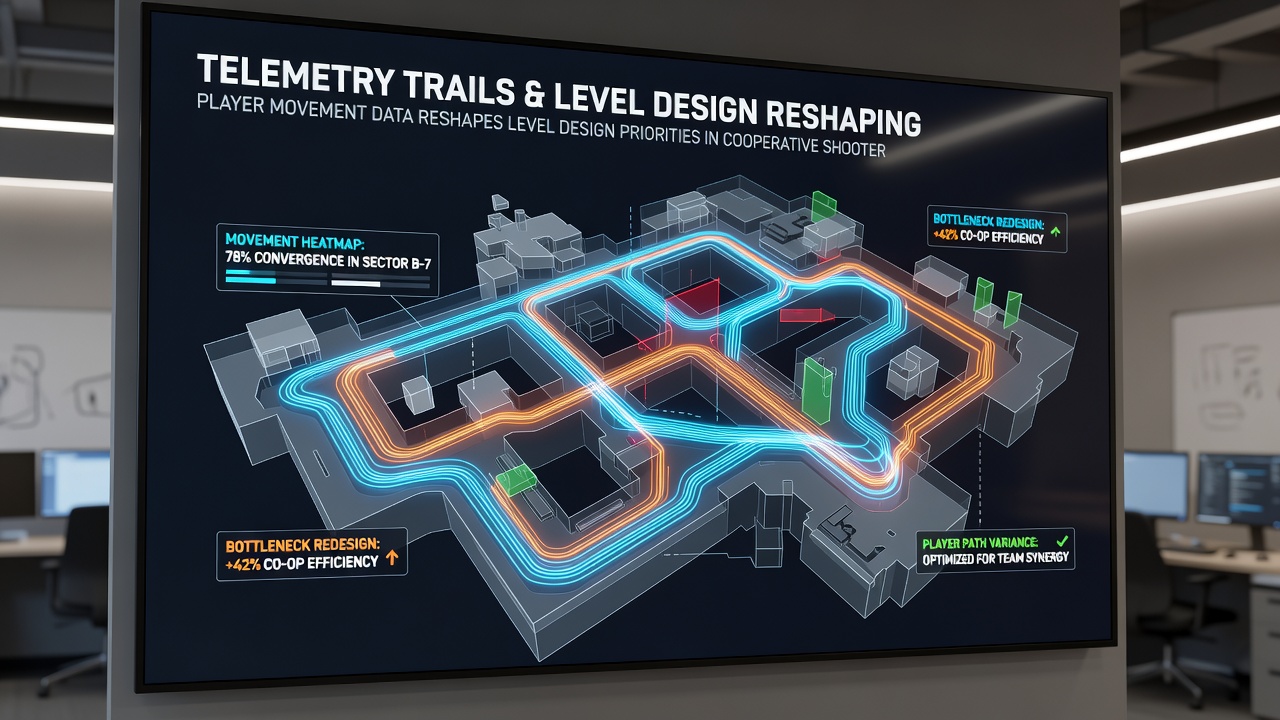
Designers place additional cover objects along routes that telemetry shows receive low traffic, which raises overall map utilization. They also remove or relocate power-up stations that sit at dead ends once data proves teams rarely reach them before the objective timer expires. In one documented case, a European studio added a zip-line system after logs revealed that 78 percent of squads bypassed an underground tunnel entirely on controller-based platforms.
Impact on Cooperative Objectives and Pacing
Movement data has shifted objective placement away from linear sequences and toward circular or branching layouts that keep all squad members moving. When trails show repeated backtracking, designers introduce dynamic doors or moving platforms that force the group to split and regroup. These changes reduce idle time and increase the frequency of coordinated pushes. Reports from the Entertainment Software Association note that titles incorporating such revisions saw average session length rise by 11 minutes across PC and console players during the spring 2026 season.
Because telemetry records both successful and failed attempts, developers can identify which movement routes correlate with mission completion rates above 70 percent. They then reinforce those routes with additional cover and line-of-sight blockers while thinning out underused areas. Mobile versions receive further simplification of these routes to match shorter attention spans and smaller viewports.
Conclusion
Telemetry trails have become a standard reference during the level design process for cooperative shooters, and the resulting adjustments appear consistently across digital platforms. Movement data continues to guide decisions about path width, verticality, objective spacing, and platform-specific scaling. As collection methods grow more granular, designers expect further refinements that align map geometry with actual player behavior rather than assumed patterns.