Server Migration Sagas: Player Communities Adapting to Infrastructure Changes in Longstanding Multiplayer Titles
Written by Tina Bennett · Aug 19, 2026
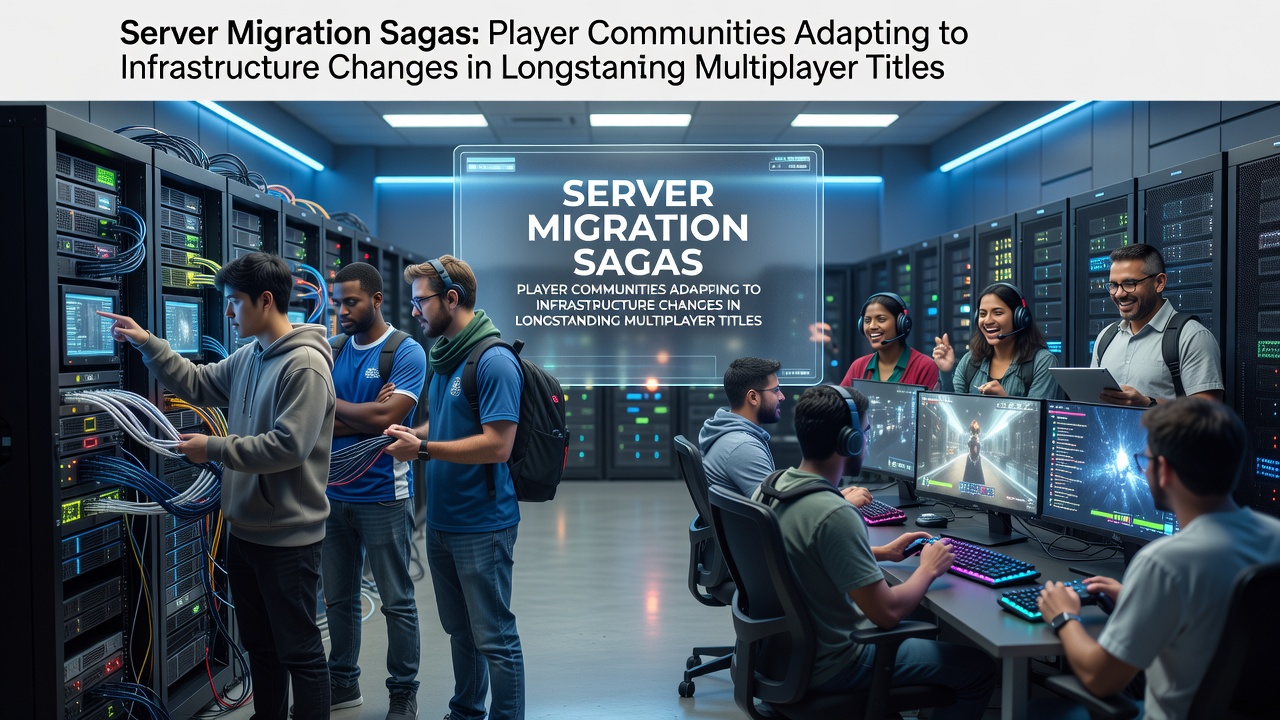
Server Migration Sagas: Player Communities Adapting to Infrastructure Changes in Longstanding Multiplayer Titles
Server migrations have become a recurring event in longstanding multiplayer titles where operators shift infrastructure to new data centers or cloud providers, and player communities respond by reorganizing around updated latency patterns and revised social structures. Research from industry monitoring groups shows that these transitions often span several months while developers coordinate hardware upgrades, software patches, and player notifications to minimize downtime across global regions.
Patterns in Infrastructure Shifts
Developers of established games such as massively multiplayer online role-playing titles and persistent shooter franchises have documented multiple migration cycles since the early 2010s, with activity accelerating in 2026 as providers phase out older hardware clusters. In August 2026 several legacy servers for popular PC and console cross-play titles completed transitions to distributed cloud nodes, which altered connection routing for users in North America, Europe, and Asia-Pacific zones simultaneously. Data from network analytics firms indicates average ping reductions of 15 to 30 milliseconds in some regions after rerouting, although temporary spikes occurred during the switchover windows.
Observers note that communities track these changes through dedicated forums and in-game chat channels where players share updated connection logs and coordinate group activities around new server time zones. One documented case involved a strategy game community that rebuilt its alliance structures after a migration redistributed population across previously underused instances, allowing smaller guilds to gain visibility they lacked on the original hardware setup.
Community Response Mechanisms
Player groups adapt through organized data collection efforts, compiling spreadsheets of latency measurements before and after each migration phase to identify optimal play windows. These records circulate on external platforms, enabling participants to adjust schedules and hardware configurations without relying solely on official developer announcements. Studies from academic institutions in Canada have examined how such collective mapping reduces individual frustration by distributing technical troubleshooting across volunteer moderators who verify claims against official patch notes.

What's interesting is how regional player bases form temporary alliances during transitions, pooling resources to test new routing paths and report anomalies to support teams. Figures from the European Games Developer Federation reveal that titles with active community councils experience faster stabilization periods, often measured in weeks rather than months, because players surface edge-case issues through structured feedback channels rather than scattered individual tickets.
Technical and Social Adjustments
Infrastructure changes frequently coincide with updates to anti-cheat systems or matchmaking algorithms, which require communities to recalibrate strategies around revised player distribution. Those who've studied migration timelines observe that longstanding titles benefit from pre-existing documentation archives where veterans maintain historical records of past server states, allowing newer participants to understand recurring patterns without starting from scratch each cycle. And yet the process still demands active participation because each migration introduces variables tied to specific cloud provider policies or regional regulations.
People often find that social tools evolve alongside the servers, with groups migrating their coordination hubs to platforms that support better file sharing for updated configuration guides. Research indicates that retention rates improve when developers provide transparent timelines and rollback options, giving communities time to experiment with alternative playstyles during the adjustment window.
Broader Industry Context
According to reports compiled by the Australian Interactive Games Association, server migrations represent a growing share of operational budgets for publishers maintaining decade-old titles, driven by rising energy costs and demands for higher player concurrency. These expenditures translate into visible improvements in uptime metrics, which in turn support sustained community events such as seasonal tournaments that rely on stable cross-region connections. Observers note that titles undergoing regular infrastructure refreshes maintain higher concurrent user counts compared with those that delay upgrades until hardware failures force reactive changes.
Conclusion
Server migrations continue to shape the operational landscape of longstanding multiplayer titles, prompting player communities to develop systematic approaches for tracking, testing, and reorganizing around new infrastructure realities. Data compiled across multiple regions demonstrates measurable impacts on connection quality and social dynamics, while also highlighting the value of transparent communication from operators. As cloud technologies advance, further cycles will likely test these adaptation strategies on an even larger scale, with communities leveraging accumulated knowledge to navigate each transition more efficiently than the last.