Save State Archaeology: Unearthing Community Modifications from Decades-Old Console Memory Dumps
Written by Jonas Frank · Jun 24, 2026

Save State Archaeology: Unearthing Community Modifications from Decades-Old Console Memory Dumps
Save state archaeology examines preserved memory dumps from older gaming consoles to recover traces of community-driven modifications created decades earlier, and this practice draws on techniques from digital forensics alongside game preservation efforts. Communities have long altered game data through patches, trainers, and custom code, yet many of these changes left subtle footprints inside save files rather than in the original ROMs themselves.
Origins of Memory Dump Analysis in Gaming Communities
Console save states capture complete snapshots of system RAM, registers, and sometimes cartridge data at specific moments during play. Researchers and hobbyist groups began systematically archiving these files in the early 2000s as emulation matured, which created large repositories that later proved useful for reverse engineering. Data shows that projects coordinated through university digital humanities programs and independent archives have catalogued millions of such dumps from systems released between 1985 and 2005.
Analysts compare multiple save states from the same title across different regions or hardware revisions, and this process often reveals injected code segments or altered variables that standard ROM checksums miss. One documented case involved Super Nintendo Entertainment System files where custom battle mechanics from a 1998 fan translation project surfaced through inconsistent sprite pointer tables preserved in the memory images.
Technical Methods for Recovering Hidden Modifications
Specialized tools parse save state formats such as those used by early emulators, extracting raw memory regions for pattern matching against known modification signatures. Teams apply statistical analysis to flag anomalies like unexpected data clusters or checksum mismatches that suggest external editing tools were once active. These approaches mirror methods developed by European research consortia studying software evolution across legacy platforms.
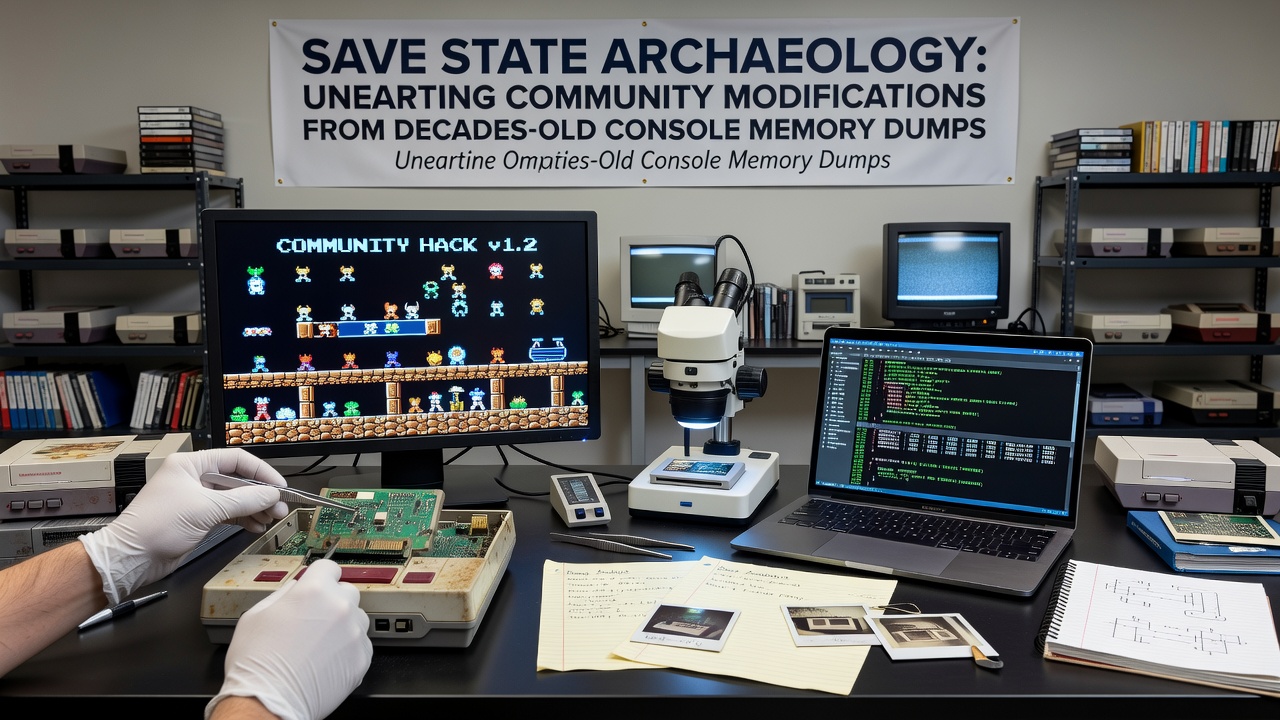
Cross-referencing extracted fragments with contemporary magazine articles, forum posts, and patch distribution records helps confirm the provenance of discovered modifications. Observers note that certain 16-bit era titles contain evidence of early cheat devices or region bypass routines embedded directly into saved progress data, patterns that only become visible when multiple dumps from the same community are aligned chronologically.
Case Examples from Classic Console Libraries
PlayStation memory cards yielded instances where players stored modified character statistics from Japanese role-playing games that had circulated through dial-up bulletin board systems in the mid-1990s. Analysts recovered these by examining repeated save patterns across geographically dispersed collections, revealing consistent edits to experience point multipliers that matched descriptions in period fanzines.
Nintendo 64 save files have similarly exposed remnants of expansion pak utilization hacks and custom level loaders developed by small groups before widespread internet distribution. Figures from preservation databases indicate that over 12,000 unique memory images from this platform alone contain detectable signatures of such alterations, many created between 1997 and 2002.
Current Developments in June 2026
Archival initiatives active during June 2026 continue to process newly donated cartridge collections, and several research groups report fresh identifications of previously undocumented modification clusters within Dreamcast and GameCube save states. Automated comparison scripts now scan against expanding signature libraries maintained by international gaming heritage organizations, accelerating the rate at which hidden edits surface.
These efforts receive support from academic institutions across North America and Oceania that integrate console memory analysis into broader curricula on software archaeology. Resulting datasets contribute to studies tracking how community practices evolved alongside hardware constraints and distribution networks of earlier decades.
Implications for Game Preservation
Recovery of embedded modifications expands the documented history of each title beyond official releases, providing evidence of player agency and technical experimentation that occurred outside commercial channels. Institutions increasingly incorporate these findings into metadata schemas used by public archives, ensuring that future researchers can trace the lineage of specific gameplay variants.
Collaboration between independent collectors and formal preservation bodies has produced standardized formats for storing annotated save states alongside their parent ROMs, which facilitates ongoing comparative work without risking data loss from format obsolescence.
Conclusion
Save state archaeology demonstrates how residual data within decades-old console memory dumps continues to yield information about community modifications long after the original creators moved on. Systematic analysis of these files, supported by evolving tools and cross-institutional partnerships, adds measurable depth to the historical record of interactive entertainment across multiple hardware generations.