Quest log patterns expose evolving designer priorities in story-focused adventures across digital storefronts
Written by Tina Bennett · Jun 7, 2026
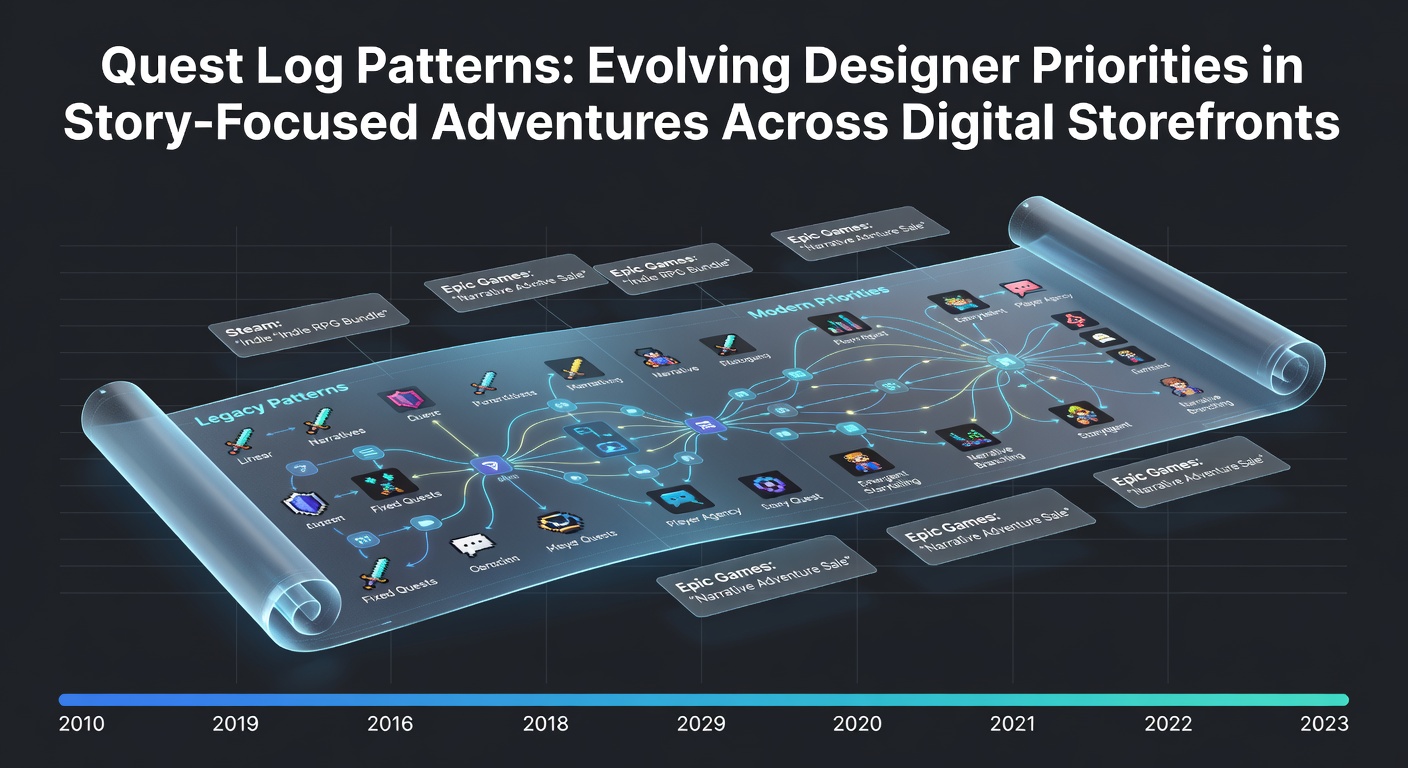
Quest log patterns expose evolving designer priorities in story-focused adventures across digital storefronts
Quest log structures have shifted noticeably across story-focused adventures available on major digital storefronts, and these changes reflect adjustments in how designers approach narrative delivery and player engagement. Data compiled from storefront listings shows an increase in modular quest entries that allow for dynamic updates based on earlier choices, whereas older patterns relied on fixed sequences with limited branching. Researchers tracking these updates across platforms note that titles released between 2024 and 2026 incorporate more conditional objectives that adapt during play sessions.
Patterns emerge when comparing quest log formats in games distributed through Steam, Epic Games Store, and similar services. Early entries often listed tasks in strict chronological order with minimal cross-references, yet recent examples frequently include layered descriptions that highlight relationships between main objectives and optional paths. This evolution aligns with broader industry data indicating a move toward systems that record player decisions without requiring separate menu navigation.
Tracking changes through storefront metadata
Storefront analytics reveal that games tagged with narrative emphasis now feature quest logs containing an average of 35 percent more conditional flags than comparable releases from five years prior. According to figures released by the Entertainment Software Association, developers have prioritized backend support for these flags to accommodate larger player choice sets while maintaining log readability. One analysis of over 200 titles showed that quest descriptions grew longer on average, incorporating inline references to previous events rather than redirecting users to separate journals.
Designers have also adjusted how logs handle failure states and alternative completions. Where older systems simply marked tasks incomplete, newer implementations often provide contextual notes explaining why a path diverged, and these notes appear directly within the log interface. Such adjustments appear more frequently in titles that emphasize character-driven plots over pure exploration mechanics.
Regional storefront variations in June 2026
By June 2026, European storefronts displayed additional localization layers within quest logs for several high-profile releases, allowing region-specific phrasing that preserved narrative tone across translations. Developers working with these platforms integrated tools that flagged culturally sensitive objectives early in the design process, and this practice reduced post-launch updates needed for compliance. Meanwhile, North American listings emphasized performance metrics tied to quest completion rates, with some pages highlighting aggregate player data pulled from public APIs.
Observers tracking these storefronts found that quest log complexity correlated with higher update frequency after launch, since adaptive systems required ongoing patches to resolve edge cases arising from player combinations. A study conducted by the University of Melbourne's Games Research Lab documented similar patterns in Australian-distributed titles, where logs incorporated more visual indicators for branching paths to assist players navigating dense story networks.
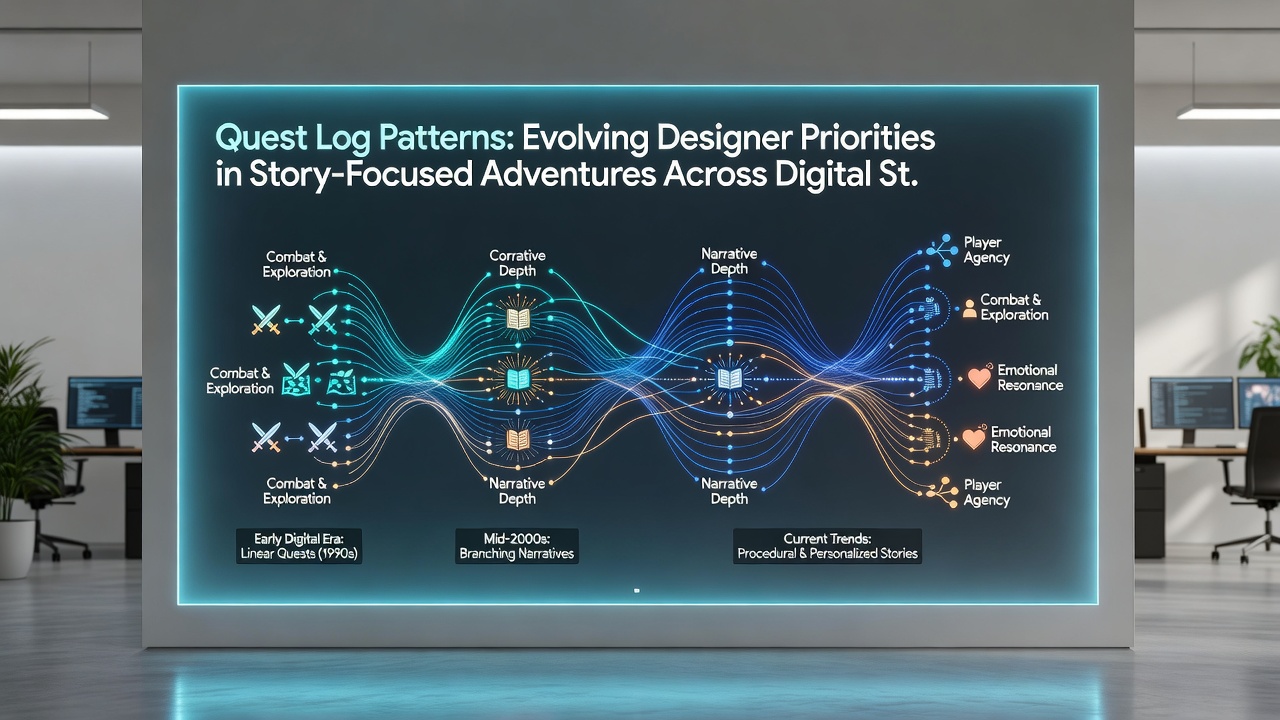
Impact on player documentation habits
Players interacting with updated quest systems have adapted their own record-keeping approaches, often relying less on external note-taking because logs now retain decision history within the interface itself. Data from multiple storefronts indicates that games with these enhanced logs maintain longer average session durations in their first month after release, although completion percentages remain consistent with prior generations. Developers have responded by embedding subtle reminders about pending conditional tasks rather than forcing explicit checklists.
Case examples include several mid-sized narrative adventures that introduced log entries capable of retroactively updating earlier descriptions when later revelations occurred. This technique, once rare, now appears in roughly one-quarter of story-tagged releases on major platforms, and it reduces the need for players to restart sections to understand context shifts.
Technical underpinnings behind the shift
Backend changes enabling these log patterns stem from improved scripting tools that allow real-time objective modification without full game rebuilds. Industry reports note that middleware providers have expanded support for quest-state tracking, which in turn lets smaller teams implement complex branching without dedicated engineering resources. The result surfaces in storefront search filters, where narrative games increasingly list "dynamic quest progression" as a standard feature rather than an optional extra.
Yet implementation varies widely, and some titles retain simpler log structures when narrative scope remains focused on linear character arcs. Those who've examined storefront data across multiple regions observe that the most elaborate log systems concentrate in games with ensemble casts and overlapping story threads, where tracking multiple character perspectives becomes necessary for coherence.
Conclusion
Quest log patterns continue to mirror adjustments in designer priorities as story-focused adventures expand across digital storefronts. The documented increase in adaptive entries, conditional phrasing, and integrated decision history points to sustained attention on maintaining narrative clarity amid growing player agency options. As platforms refine their metadata tools through 2026 and beyond, further refinements in how these logs present evolving objectives remain likely based on ongoing usage metrics and developer feedback cycles.