How Regional Server Infrastructures Influence Competitive Balance in Global Online Gaming Communities
Written by Jonas Frank · Jun 5, 2026
How Regional Server Infrastructures Influence Competitive Balance in Global Online Gaming Communities
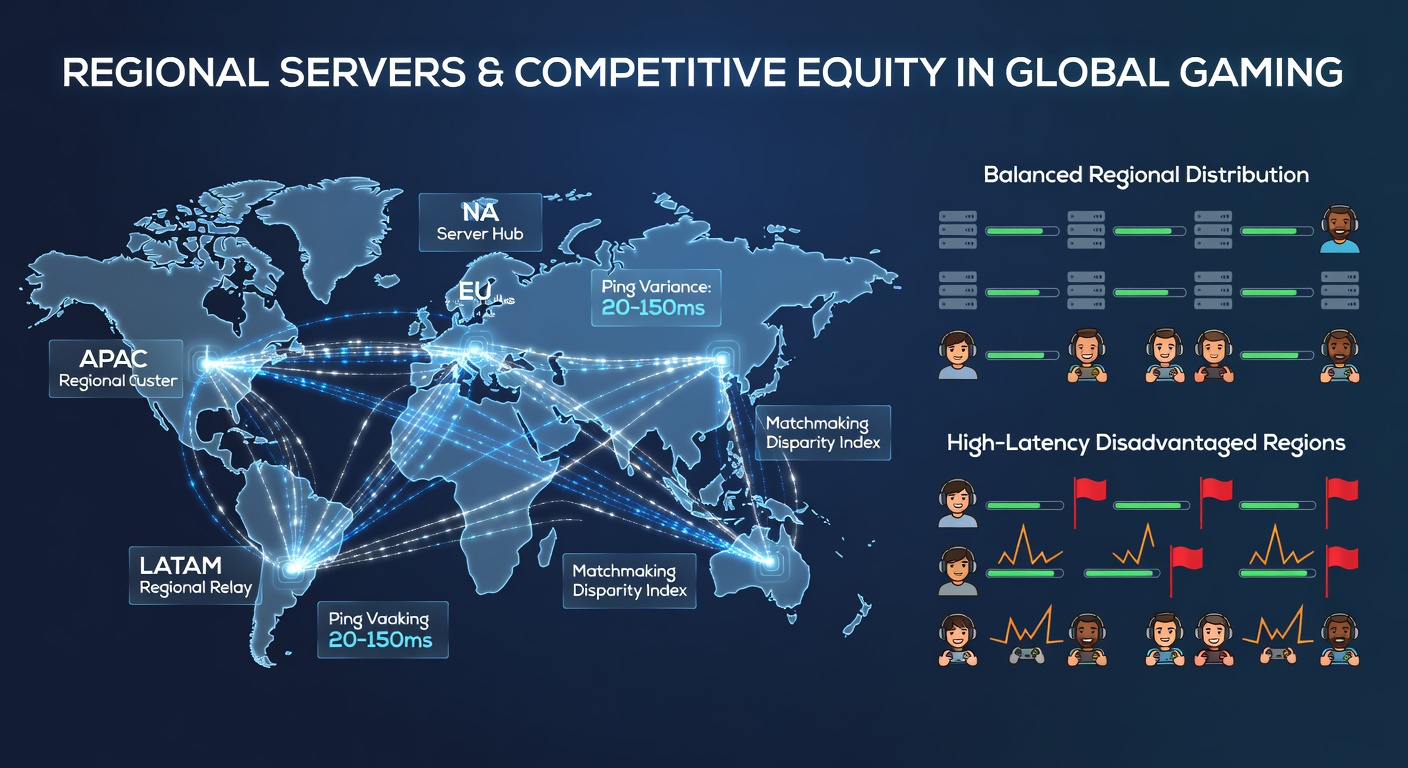
Regional server infrastructures shape competitive balance in global online gaming communities through their direct effects on latency, matchmaking systems, and access to high-quality connections. Data centers located in specific geographic zones create measurable differences in player performance, and these differences appear consistently across titles that rely on real-time interaction such as MOBAs, battle royales, and fighting games.
Connection quality depends on physical distance to the nearest server cluster, and players in regions with dense infrastructure enjoy lower ping values while those farther away face higher latency. Studies on network performance indicate that each additional 50 milliseconds of round-trip time can reduce accuracy in aim-based games by noticeable margins, shifting win rates in ranked ladders where small edges compound over hundreds of matches.
Latency Patterns and Infrastructure Density
Server placement follows population centers and undersea cable landing points, which concentrate high-performance nodes in North America, Western Europe, and East Asia. Communities in South America, Africa, and parts of Southeast Asia often route traffic through longer paths, and this routing produces average latencies above 80 milliseconds even during off-peak hours. In June 2026, several international qualifiers for major tournaments documented these gaps when teams from different continents competed on the same client version yet experienced distinct response times.
Network operators have expanded peering agreements in recent years, yet gaps remain visible in publicly available traceroute data collected by gaming platforms. These gaps affect not only casual play but also professional scouting, since emerging talent from underserved regions must overcome higher baseline latency before reaching global leaderboards.
Matchmaking Algorithms and Regional Pools
Matchmaking systems incorporate geographic restrictions to maintain acceptable ping ranges, and this design choice segments player bases into regional queues. While the approach reduces average latency within each pool, it also limits cross-region competition and creates separate skill distributions. Observers note that leaderboards in well-served regions display tighter rating spreads, whereas queues in distant areas show wider variance because fewer high-skill players participate consistently.
Some platforms have introduced optional global queues with relaxed latency thresholds, and participation data reveals that players from infrastructure-rich zones rarely select these options while those from peripheral regions do so more frequently. The resulting imbalance appears in aggregate statistics published by game publishers, which show regional win-rate divergences that persist across multiple seasons.
Case Examples from Popular Titles
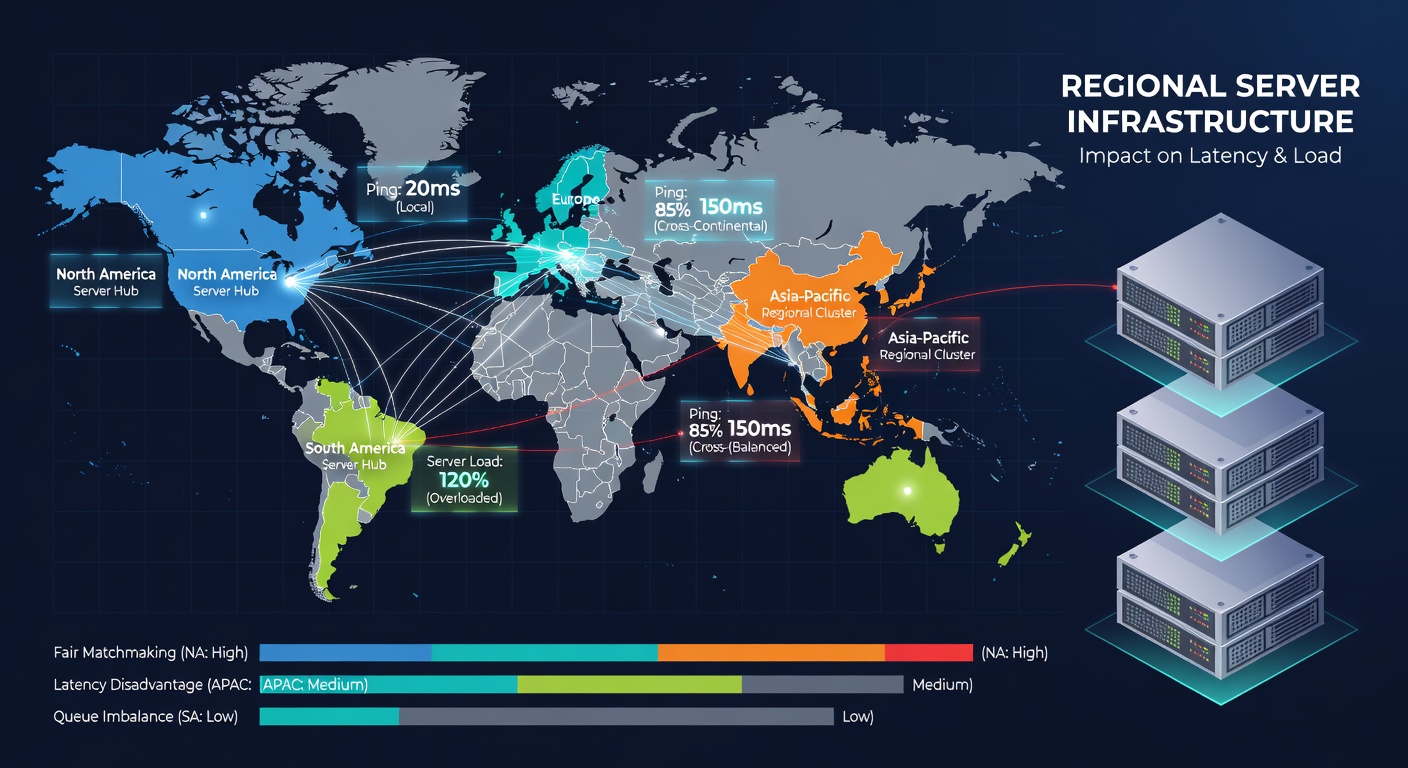
League of Legends maintains separate server clusters for each major region, and historical data from Riot Games shows that players on the North American and European servers achieve higher average mechanical scores in equivalent skill brackets compared with those on Latin American servers. Similar patterns emerge in Valorant, where agent pick rates and round-win percentages differ measurably between the São Paulo and Miami data centers despite identical game versions.
Fortnite and Call of Duty titles employ dynamic server allocation, yet reports from the International Telecommunication Union on broadband distribution indicate that regions with fewer peering points still record higher packet loss during peak tournament hours. Fighting game communities face additional constraints because rollback netcode, while helpful, cannot fully compensate for latencies above 120 milliseconds that remain common in parts of Oceania and Sub-Saharan Africa.
Professional Circuits and Talent Pipelines
Esports organizations scouting for international rosters have adjusted recruitment strategies around server geography, and academy programs now prioritize players who can demonstrate performance on low-latency infrastructure before relocation. In June 2026, several academy teams hosted joint boot camps that required participants to travel to central server hubs, underscoring the practical advantage of proximity.
Training regimens documented by competitive teams include dedicated practice on foreign servers through VPN routing, though this workaround introduces its own jitter and does not replicate native conditions. Researchers at institutions tracking digital infrastructure, including publications from MIT’s Center for Bits and Atoms, have modeled how incremental improvements in regional fiber density correlate with increased representation from those areas in global leaderboards over multi-year periods.
Conclusion
Regional server infrastructures continue to define access gradients within global online gaming communities, and the resulting competitive imbalances appear in both casual and professional contexts. Continued expansion of edge computing nodes and improved international peering may narrow these gaps, yet current deployment patterns maintain distinct performance tiers tied directly to geographic location. Players, developers, and tournament organizers operate within these constraints, and data from network monitoring services confirm that infrastructure distribution remains a primary variable in cross-regional outcomes.