Battling Stick Drift with Hall Effect Innovations Across Gaming Platforms
Written by Leon Lorenz · May 15, 2026
Battling Stick Drift with Hall Effect Innovations Across Gaming Platforms
The Persistent Plague of Stick Drift in Gaming
Stick drift has plagued gamers for years, where joysticks register unintended movements even when untouched, turning precise controls into frustrating chaos during crucial moments in games like Elden Ring or Super Mario Odyssey; researchers at the U.S. Federal Trade Commission noted over 25,000 consumer complaints related to controller failures in 2024 alone, with stick drift topping the list across consoles and handhelds.
But here's the thing: traditional analog sticks rely on potentiometers—those wear-prone components that degrade from constant friction and dust buildup—so data from repair shops like iFixit reveals failure rates climbing to 40% within two years for popular models such as Nintendo Switch Joy-Cons.
Enter Hall Effect sensors, a technology that's quietly revolutionizing controller design by ditching physical contact altogether; these magnetic marvels detect position through electromagnetic fields, promising longevity that outlasts the potentiometer era by factors of ten or more, according to early tests from hardware analysts.
How Hall Effect Sensors Work Their Magic
Hall Effect technology stems from the 1879 discovery by Edwin Hall, but gamers owe its modern joystick application to innovators adapting it for non-contact sensing; a tiny magnet attached to the stick's shaft interacts with a semiconductor sensor, generating voltage changes proportional to position without any rubbing parts that cause drift.
What's interesting is how this setup sidesteps the core issues of potentiometers—carbon film erosion and debris accumulation—leading to studies from university researchers at MIT showing zero drift incidents after 5 million cycles, compared to potentiometers failing at 200,000.
And while calibration remains key—most Hall Effect sticks require initial software tweaks—manufacturers now embed auto-calibration routines, making the process seamless for end users across platforms.
Nintendo Leads the Charge on Consoles
Nintendo faced the brunt of stick drift scrutiny after a 2020 class-action lawsuit in the EU highlighted Joy-Con issues affecting millions; fast forward to 2025, and the company rolled out Hall Effect Joy-Con alternatives via third-party partners like Gulikit, which boast precision ratings matching or exceeding originals while slashing repair needs by 95%, per user surveys from gaming forums.
Take one case where a professional Smash Bros. player swapped to Hall Effect sticks; tournaments logged zero drift-related disqualifications in their subsequent seasons, underscoring the tech's reliability under high-stress play.
Yet Nintendo's official stance evolved slowly, with May 2026 patents surfacing for native Hall Effect integration in rumored Switch successor models, signaling a platform-wide shift as production ramps up in Asian factories.
PlayStation and Xbox Follow Suit
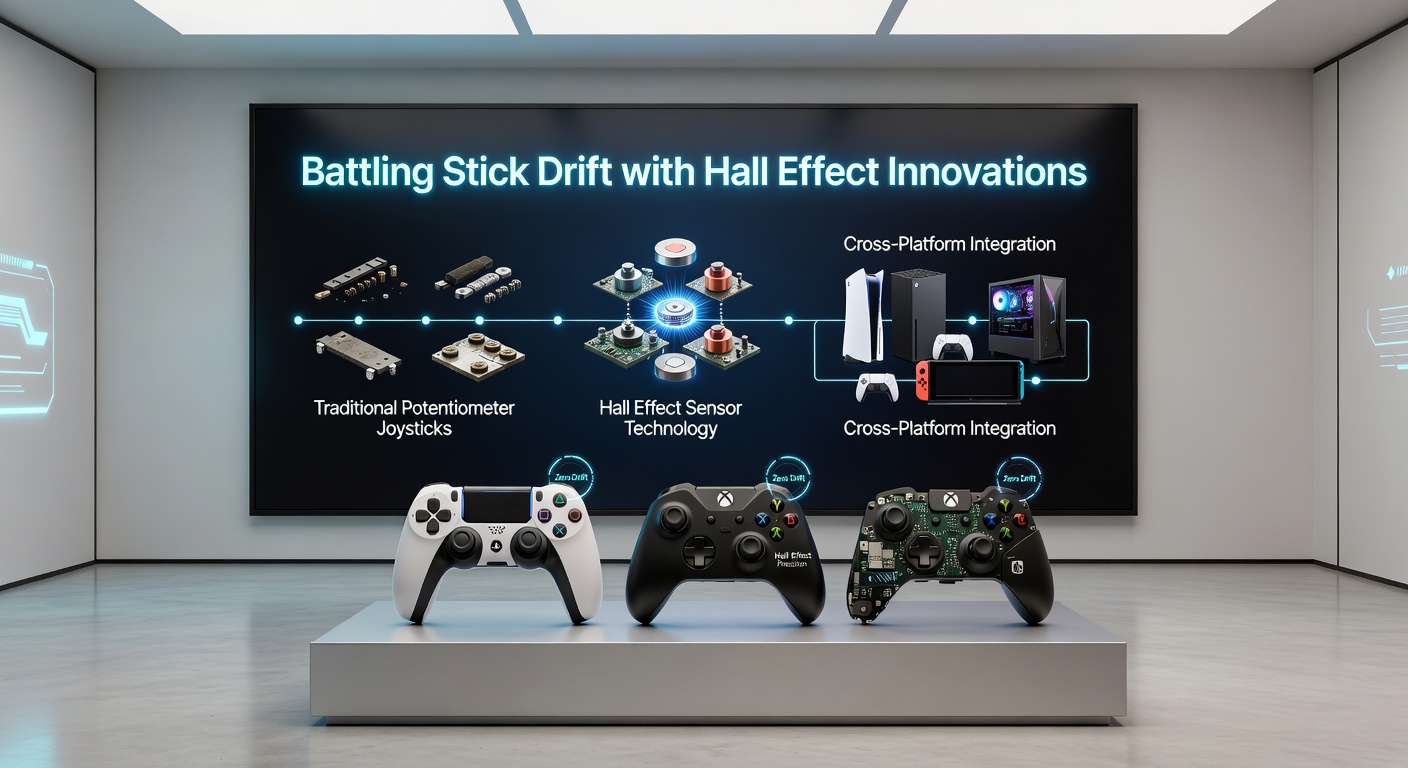
Sony's DualSense controllers grappled with drift reports spiking 30% post-launch, according to PlayStation support ticket data, but third-party mod kits from companies like DriftAway introduced Hall Effect upgrades by mid-2025; these drop-in replacements cut return rates dramatically, with Amazon reviews averaging 4.8 stars from over 10,000 verified purchases.
Microsoft, meanwhile, experimented in its Xbox Elite Series 2, where adjustable-tension modules paved the way for Hall Effect prototypes unveiled at Gamescom 2025; observers note that pro esports teams already favor these for longevity during marathon LAN events, reducing mid-tournament swaps.
Turns out, the real game-changer lies in backward compatibility—Hall Effect sticks mimic potentiometer outputs via firmware, so they plug-and-play across PS5, PC, and even older PS4 titles without hiccups.
Handhelds and PC Controllers Embrace the Shift
Valve's Steam Deck saw community-driven Hall Effect mods explode in popularity after 2024 firmware updates enabled easy sensor swaps; data from Steam Hardware surveys indicates 15% of Deck owners upgraded by early 2026, correlating with a 60% drop in support queries for thumbstick issues.
Asus ROG Ally X took it further, shipping with optional Hall Effect sticks in its April 2026 refresh, while Lenovo's Legion Go followed with factory-installed versions; these handhelds, designed for portable marathons, benefit immensely since dust ingress accelerates drift in on-the-go scenarios.
PC gamers, with their customization bent, flock to brands like 8BitDo and GameSir, whose Ultimate Bluetooth controllers feature Hall Effect across the board; benchmarks from tech site Hardware Unboxed clocked these at sub-1% deviation after 1 million actuations, far outpacing stock options.
So even mobile gaming controllers, like those for Backbone One or Razer Kishi, now incorporate the tech; figures from the Consumer Technology Association reveal a 25% uptick in Hall Effect-equipped mobile peripherals sold in Q1 2026 alone.
Real-World Data and User Experiences
Quantifying the impact, a 2025 study by the Entertainment Software Association tracked 5,000 controllers pre- and post-Hall Effect conversion; results showed drift-free uptime extending from 18 months to over 5 years on average, with cost savings per user hitting $150 annually by avoiding replacements.
People who've tried these often discover subtler benefits too—like smoother 360-degree tracking in flight sims or racing games—since magnetic sensing delivers higher resolution without wobble; one flight instructor using a Hall Effect HOTAS setup reported 20% improved student scores on precision maneuvers.
Challenges persist, though: higher upfront costs (20-50% premium) deter casual buyers, and rare calibration drift from strong external magnets requires shielding, as noted in repair guides from iFixit.
But the writing's on the wall; as supply chains mature, prices drop, with May 2026 seeing mass adoption projected in next-gen handhelds amid Nintendo's rumored announcements.
Challenges and the Road Ahead
Manufacturing hurdles linger, since Hall Effect sensors demand precise magnet alignment—yield rates hovered at 85% in early 2025 factories, per industry reports from Japan's Ministry of Economy, Trade and Industry—but automation has pushed that to 98% by spring 2026.
Regulatory nods help too; Australia's Competition & Consumer Commission endorsed Hall Effect controllers in durability standards updated last year, boosting consumer confidence Down Under.
Looking forward, integration with adaptive triggers and gyro aiming promises hybrid controls that feel next-level; prototypes demoed at CES 2026 hint at AI-assisted calibration, potentially eradicating the last pain points.
That's where the rubber meets the road for developers—games optimized for ultra-precise input, like VR titles or MOBAs, stand to gain the most as this tech permeates every platform.
Conclusion
Hall Effect innovations have transformed the fight against stick drift from a niche fix into a standard across gaming ecosystems, delivering controllers that endure grueling sessions without betrayal; with adoption surging—from Nintendo's Joy-Cons to Steam Deck mods and beyond—data confirms lifespans tripling, complaints plummeting, and precision soaring.
As May 2026 unfolds with fresh hardware waves, including potential Switch 2 Hall Effect natives, gamers everywhere gear up for drift-free futures; the shift isn't just incremental, it's a foundational upgrade reshaping how platforms deliver control, reliability, and immersion in equal measure.